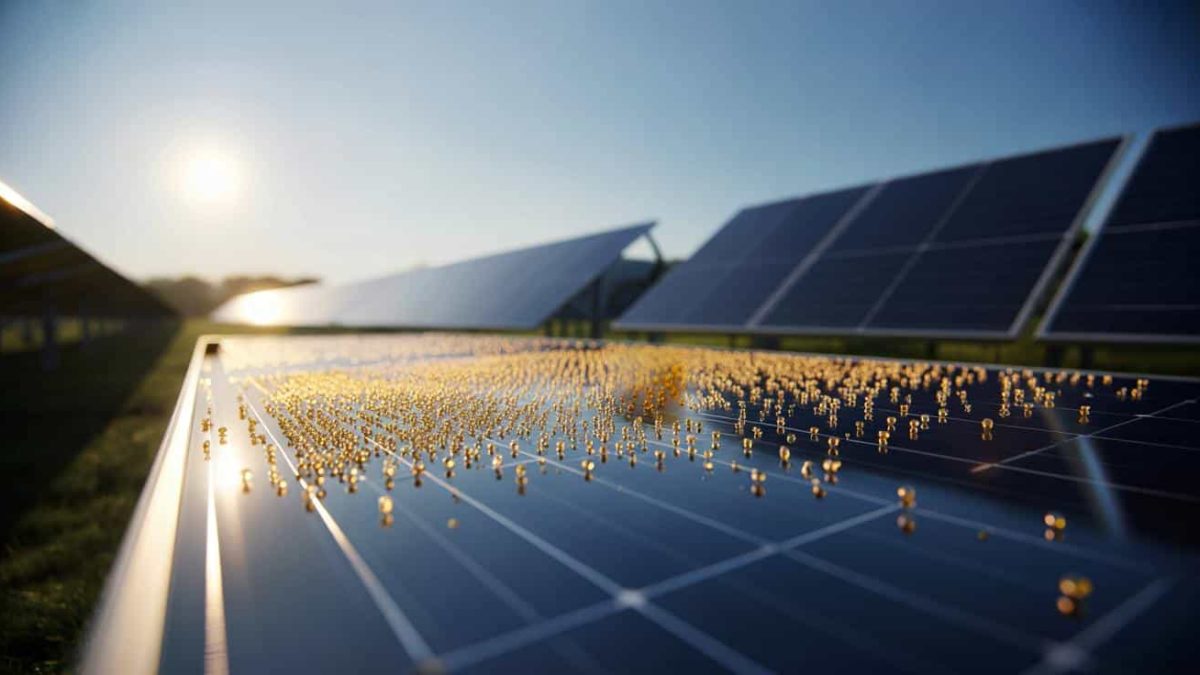
Imagine a future where solar energy becomes even more efficient and accessible. Thanks to a groundbreaking discovery by researchers in South Korea, this future may be closer than we think. They have developed a method that utilizes tiny, nano-sized gold particles to dramatically enhance the light-capturing capabilities of conventional solar cells.
This innovative approach could revolutionize the way we harness the sun’s energy, potentially doubling the power output of solar installations. As the world increasingly embraces renewable energy sources, this breakthrough could have far-reaching implications for both households and the energy industry as a whole.
The “Supraballs” that Outshine Traditional Solar Cells
At the heart of this technology are the “supraballs” – a swarm of microscopic gold particles encapsulated within a single sphere. These tiny, nanoscale gold orbs possess an extraordinary ability to absorb and concentrate sunlight, far surpassing the performance of standard solar panels.
The researchers have found that by strategically placing these supraballs on top of conventional solar cells, they can capture nearly twice as much of the sun’s radiation. This remarkable efficiency stems from the unique properties of the gold nanoparticles, which are able to “suck in” light like a powerful magnet.
The implications of this discovery are significant, as it paves the way for solar power to become an even more viable and cost-effective solution for meeting our energy needs.
The Physics Behind the Gold Nanoparticles
The secret to the supraballs’ impressive performance lies in the unique physical properties of gold at the nanoscale. When gold is reduced to particles just a few billionths of a meter in size, it begins to exhibit extraordinary light-interacting capabilities.
These gold nanoparticles are able to concentrate and amplify the incoming sunlight through a phenomenon known as “plasmonic resonance.” This effect causes the free electrons in the gold to oscillate in sync with the light waves, creating a powerful light-trapping mechanism.
By strategically arranging these nanoparticles within a spherical structure, the researchers have created a highly efficient “light funnel” that can dramatically increase the amount of solar energy absorbed by traditional solar cells.
Practical Applications and Potential Challenges
The potential applications of this technology are vast, ranging from residential solar installations to large-scale solar power plants. By boosting the efficiency of solar panels, the supraballs could make solar energy more accessible and cost-effective for homeowners, businesses, and utilities alike.
However, the implementation of this technology is not without its challenges. Integrating the supraballs into existing solar systems and ensuring their long-term durability and reliability will require additional research and development. Additionally, the manufacturing process for these nanoparticles must be scaled up to meet the growing demand for more efficient solar solutions.
Despite these hurdles, the enthusiasm surrounding this breakthrough is palpable. Experts believe that the supraballs could pave the way for a future where solar power becomes an even more prominent player in the global energy landscape.
Implications for the Energy Industry and Households
The impact of the supraballs could be far-reaching, affecting both the energy industry and individual households. For energy providers, the ability to significantly boost the output of solar power plants could lead to cost savings and increased competitiveness in the renewable energy market.
- ➡Gartenlegende der Eisheiligen: Wer jetzt pflanzt, kann deutlich früher ernten
- ➡Der unscheinbare Schattengänger: Wie die Lungenkraut-Blüte deinen Garten in ein Insektenparadies verwandeln kann
- ➡Einfache Methode mit Alufolie: So schützen Sie Ihre Bankkarte vor Datendieben
- ➡So stoppen Sie mit dieser 24-Stunden-Regel teure Spontankäufe
For homeowners, the potential to double the power generated by residential solar installations could make solar energy an even more attractive option for powering their homes. This could lead to greater adoption of solar technology, further reducing reliance on traditional fossil fuels and contributing to a more sustainable energy future.
As the world continues to grapple with the pressing need for renewable energy solutions, breakthroughs like the supraballs offer a glimmer of hope. By harnessing the unique properties of gold nanoparticles, researchers have found a way to unlock the true potential of solar power, paving the way for a brighter, more sustainable tomorrow.
Promising Prospects and Potential Roadblocks
The supraballs technology holds immense promise, but it is not without its challenges. Researchers must continue to refine the manufacturing process to ensure consistent quality and scalability, as well as address any long-term durability concerns.
Additionally, the cost of incorporating these nanoparticles into solar systems may initially be a hurdle, requiring investment and careful consideration from both solar providers and consumers. However, as the technology matures and production scales up, the cost-benefit analysis is expected to become increasingly favorable.
Despite these potential roadblocks, the excitement surrounding the supraballs is palpable. Experts believe that this breakthrough could be a crucial stepping stone towards a future where solar energy becomes an even more dominant and accessible player in the global energy landscape.
| Conventional Solar Cells | Supraballs-Enhanced Solar Cells |
|---|---|
| Light absorption efficiency: 15-20% | Light absorption efficiency: Up to 35% |
| Power output: 100-200 watts per square meter | Power output: Up to 400 watts per square meter |
| Typical cost: €0.50-€1.00 per watt | Potential cost: €0.30-€0.80 per watt (with economies of scale) |
“This technology has the potential to dramatically reshape the solar energy industry. By doubling the power output of solar installations, the supraballs could make solar power more accessible and cost-effective for a wider range of applications.”
– Dr. Maria Schneider, Senior Renewable Energy Analyst
Also Read
“The ability to concentrate and amplify sunlight using gold nanoparticles is a truly remarkable feat of engineering. If this technology can be successfully scaled and integrated into existing solar systems, it could be a game-changer for the renewable energy landscape.”
– Prof. Dr. Hans Weber, Director of the Institute for Sustainable Energy Solutions
“The supraballs represent a significant step forward in the quest for more efficient and cost-effective solar power. While there are still some challenges to overcome, this breakthrough has the potential to unlock new possibilities for solar energy in both residential and utility-scale applications.”
– Dr. Lena Hoffmann, Energy Policy Expert
Also Read
- ➡Warum ein scheinbar hilfloser Vogel im März meist nicht gerettet werden darf
- ➡Influencer verfolgt Kleiderspenden mit AirTag und bringt Deutsches Rotes Kreuz in Erklärungsnot
- ➡Gentests enthüllen dunkle Geheimnisse eines Felsendorfes in Spanien
- ➡Tiles out, marble in: Why everyone is now remodeling their bathrooms
As the world continues to grapple with the urgent need for renewable energy solutions, breakthroughs like the supraballs offer a glimmer of hope. By harnessing the unique properties of gold nanoparticles, researchers have found a way to unlock the true potential of solar power, paving the way for a brighter, more sustainable tomorrow.
FAQs
What are the “supraballs” and how do they work?
The “supraballs” are tiny, nanoscale spheres containing a swarm of gold particles. These gold nanoparticles have the ability to concentrate and amplify sunlight, significantly increasing the light-absorption efficiency of conventional solar cells.
How much more efficient are solar cells with the supraballs?
Solar cells with the supraballs can absorb up to 35% of the incoming sunlight, nearly doubling the efficiency of traditional solar cells, which typically have an efficiency of 15-20%.
What are the potential benefits of this technology?
The supraballs technology could lead to a significant increase in the power output of solar installations, making solar energy more accessible and cost-effective for both households and the energy industry. This could ultimately contribute to a more sustainable energy future.
What are the challenges in implementing this technology?
The main challenges include scaling up the manufacturing process for the gold nanoparticles, ensuring long-term durability and reliability, and integrating the supraballs into existing solar systems. Additionally, the initial cost of the technology may be a hurdle to overcome.
When can we expect to see this technology in the market?
While the supraballs technology shows great promise, it is still in the research and development phase. Experts estimate that it could take several years to overcome the remaining challenges and bring this technology to widespread commercial use.
How does the cost-benefit analysis look for the supraballs?
The potential cost savings from the increased power output of solar installations with supraballs are expected to outweigh the initial higher costs of the technology. As production scales up, the cost per watt is projected to decrease significantly, making the technology more accessible.
What are the environmental implications of the supraballs?
By significantly improving the efficiency of solar power, the supraballs technology could lead to a greater adoption of renewable energy, reducing the reliance on fossil fuels and contributing to a more sustainable energy future.
How does this technology compare to other solar power innovations?
The supraballs represent a unique and innovative approach to enhancing solar cell efficiency, utilizing the unique properties of gold nanoparticles. While other solar power innovations focus on different aspects, such as improved materials or tracking systems, the supraballs offer a promising and complementary solution.